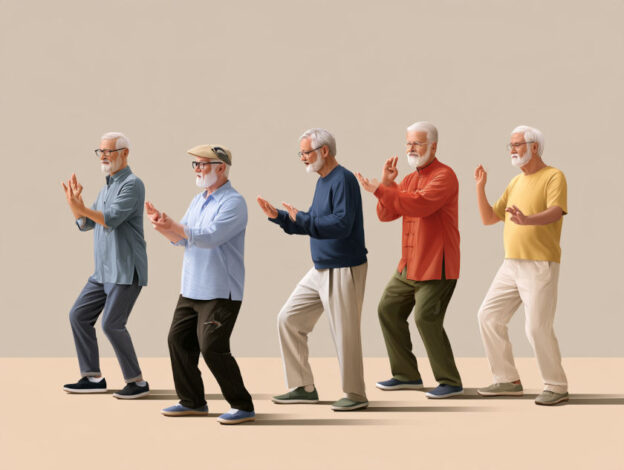
For many men who have survived cancer, finishing treatment does not necessarily mean returning to restful nights. Sleep problems can linger for years, affecting up to 60% of survivors after primary treatment. Yet research into behavioural approaches to improving sleep has largely focused on women with breast cancer, leaving older male survivors with relatively little evidence to guide them.
Researchers led by Evelyn Arana-Chicas of Rutgers Cancer Institute investigated whether Tai Chi and Qigong, traditional Chinese practices combining gentle movement, controlled breathing and meditation, could improve sleep in older men after cancer treatment. Their randomised controlled trial, published in Brain Medicine, compared these practices with conventional exercise and usual care.
The study enrolled 113 men aged 55 and older in New Brunswick and Albuquerque. Participants, whose average age was 69, had completed primary cancer treatment and experienced significant fatigue. Most were prostate cancer survivors. They were randomly assigned to Tai Chi Qigong, a carefully matched exercise programme or usual care.
Both activity groups attended hour-long classes twice weekly for 12 weeks. Tai Chi Qigong participants practised 19 exercises involving flowing movements, breathing and relaxation. The comparison group performed stretching and repetitive movements designed to match the physical demands of Tai Chi. To reduce expectations influencing results, researchers described the programmes simply as “body-mind training” and “body training”.
Attendance was encouraging, reaching 78.4% for Tai Chi Qigong and 76.8% for conventional exercise. Participants also considered both programmes similarly credible, suggesting neither approach held an obvious advantage in acceptability.
Sleep quality was assessed using the Pittsburgh Sleep Quality Index, where lower scores indicate better sleep. At the primary assessment point, three months after the programme ended, researchers found no statistically significant differences among the three groups. No direct comparison between groups reached statistical significance at any assessment.
The conventional exercise group nevertheless showed modest improvements from baseline at six weeks, immediately after the programme and three months later. Tai Chi Qigong participants experienced similar trends, although their improvements were not statistically significant. By 12 months, improvements in both groups had diminished.
One intriguing finding emerged at the one-year follow-up. Some 62% of Tai Chi Qigong participants met the questionnaire threshold for remission of sleep disturbance, compared with 47% in the exercise group and 43% receiving usual care. However, these differences were not statistically significant and cannot establish that Tai Chi was superior.
The researchers acknowledged several limitations. Sleep improvements remained below the threshold considered clinically meaningful, while the relatively small sample limited the study’s ability to detect differences. Participants were predominantly White, college-educated prostate cancer survivors, and sleep was assessed through questionnaires rather than objective monitoring.
The findings suggest that gentle movement programmes may offer modest, temporary sleep benefits for older male cancer survivors, without demonstrating a clear advantage for Tai Chi over conventional exercise. Larger, more diverse studies are needed before firm recommendations can be made. For now, the research offers a cautiously encouraging message: staying physically active may help, even if the ideal approach remains uncertain.
More information: Evelyn Arana-Chicas et al, Effects of Tai Chi Qigong on sleep quality in older male cancer survivors: A randomized controlled clinical trial, Brain Medicine. DOI: 10.61373/bm026a.0063
Journal information: Brain Medicine Provided by Genomic Press