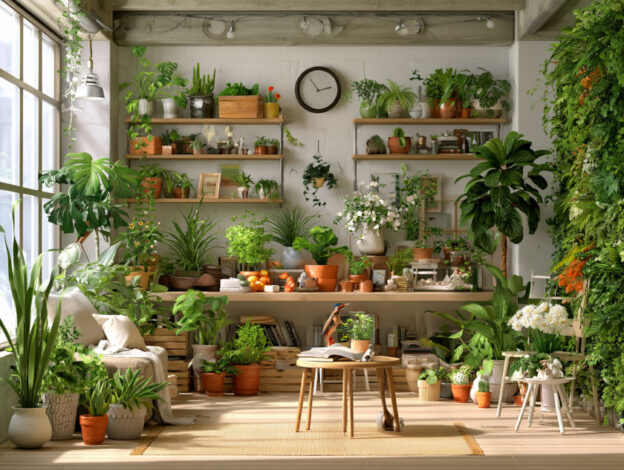
Could adding more greenery to offices and homes help create healthier, more comfortable indoor environments? An international research review suggests that indoor plants and living walls may do more than enhance the appearance of a room. From improving air quality to lowering temperatures and reducing energy consumption, indoor greenery could offer practical benefits. However, researchers caution that its effectiveness depends heavily on environmental conditions and system design.
Led by the University of Surrey, the review found that indoor plants and green walls could reduce certain airborne pollutants by approximately 10–30 per cent. Some indoor greening systems also showed the potential to reduce cooling energy requirements by up to 27 per cent in specific office zones. The findings were published in the journal Eco-Environment and Health.
The research brought together 35 international experts, led by the university’s Global Centre for Clean Air Research (GCARE), to examine studies investigating the performance of indoor greenery. Their analysis explored how different plant-based systems influence air quality, temperature and energy efficiency, while identifying the conditions under which these benefits are most likely to occur.
One promising finding concerned volatile organic compounds (VOCs), potentially harmful gases released by everyday materials such as furniture, paints and cleaning products. Ordinary potted plants and living walls demonstrated some ability to remove these pollutants. However, active systems that draw air through plants and growing materials generally performed better in controlled experiments, suggesting that design plays an important role in pollution removal.
Temperature regulation emerged as another potential advantage. Researchers found that indoor greenery was associated with local temperature reductions of approximately 0.5–4.5 degrees Celsius. Such cooling effects could improve comfort in homes and workplaces while potentially reducing dependence on air conditioning, particularly in buildings where energy efficiency is a growing priority.
Despite these encouraging results, researchers warned against assuming that all indoor plants deliver the same benefits. Factors including ventilation, lighting, plant species and system configuration can significantly influence performance. Much of the existing evidence also comes from small laboratory chambers and short experiments, raising questions about how reliably the findings translate into occupied buildings over longer periods.
Professor Prashant Kumar, GCARE’s founding director and the study’s lead author, said the review brings together evidence previously examined largely in isolation. He explained that the findings provide a preliminary benchmark for understanding where indoor greenery may work best, while highlighting the need for more reliable monitoring and predictive methods. Researchers also warned that excessive moisture during periods of extreme heat and humidity could increase condensation and mould risks.
To address these uncertainties, the team proposed a framework combining real-world monitoring with numerical modelling to evaluate indoor greenery under changing environmental conditions. GCARE researchers Dr Elisa Valentim Goulart and Dr Hao Sun emphasised that significant research gaps remain. The approach could ultimately help architects, building managers and policymakers make better-informed decisions about incorporating greenery into healthier, more energy-efficient buildings.
More information: Prashant Kumar et al, Monitoring and modelling of indoor environmental quality to guide indoor greening applications, Eco-Environment & Health. DOI: 10.1016/j.eehl.2026.100289
Journal information: Eco-Environment & Health Provided by University of Surrey