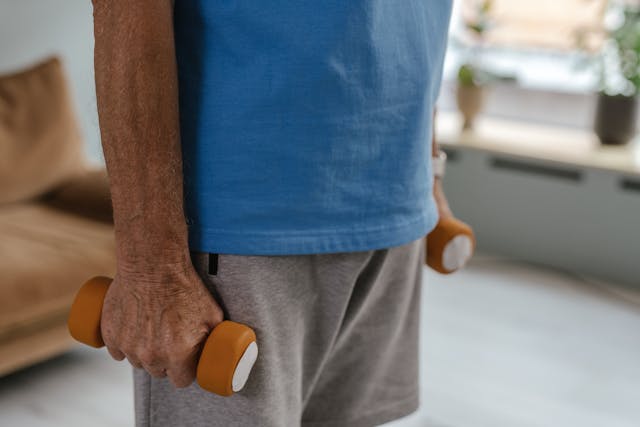
A groundbreaking international study has identified a simple yet powerful predictor of health in older adults: the ability to lift a 5-kilogram object. Led by researchers from the University of Sharjah in the United Arab Emirates and drawing data from over 51,000 individuals aged 50 and above across 15 countries, the study found a strong association between difficulty lifting 5 kg and a range of chronic illnesses and diminished quality of life. This research, published in Scientific Reports, is among the first to propose an everyday activity—lifting a modest weight—as a practical method to assess muscle strength and anticipate future health challenges.
Professor Rizwan Qaisar, the study’s lead author, explained that participants who reported struggling to lift 5 kilograms were significantly more likely to suffer from various health conditions over the following years. These included depression, chronic lung disease, stroke, hip fractures, osteoarthritis, joint disorders, high cholesterol, and even Alzheimer’s disease. Crucially, these risks persisted regardless of the participant’s age or gender, pointing to the test’s broad applicability across older demographics. The researchers argue that the inability to perform this task reflects underlying muscle weakness, a condition that often goes undetected until it contributes to serious illness or disability.
Traditional methods for assessing muscle strength typically involve costly equipment and specialised clinical settings, limiting their accessibility—especially in low-resource environments. This new approach, by contrast, empowers individuals to conduct a basic health check using nothing more than an everyday household object. A 5-kilogram item could be a bag of sugar, a small kitchen appliance, or a medium-sized pet. If such an object feels difficult to lift, it may be an early signal of muscular decline, foreshadowing more serious health deterioration.
The study’s significance extends beyond merely identifying correlations. By analysing data from the Survey of Health, Ageing, and Retirement in Europe (SHARE) between 2013 and 2020, the researchers found that nearly 20% of participants initially struggled to lift 5 kg. Over the following four years, those individuals were more likely to develop a lower quality of life, experience depression, and exhibit weaker grip strength. Osteoarthritis was also notably more common in this group. These findings held even after adjusting for age and gender, reinforcing the robustness of the 5 kg test as a predictive measure.
Notably, men who reported difficulty lifting 5 kilograms were at a higher risk than women for developing many of these conditions, suggesting potential biological or lifestyle-related differences in how muscle weakness manifests and affects overall health. The study emphasises that muscle weakness should not be viewed as a natural or harmless aspect of ageing. Instead, it represents a clear and measurable risk factor for multiple chronic diseases. Early detection through simple tests could facilitate prompt intervention and prevent the progression of debilitating conditions.
The researchers stress the urgency of integrating this test into broader public health strategies. “Lifting 5 kilograms: a simple act, a powerful health predictor,” co-author Dr Fabio Franzese of the SHARE Berlin Institute stated. He highlighted how lifting a modest weight, when viewed through the lens of clinical research, becomes a valuable tool for early intervention. The implications are vast—not only for individual self-assessment but also for enabling healthcare professionals to identify at-risk patients without costly diagnostic technologies.
Professor Azhar Hussain, another co-author from the University of Sharjah, echoed this sentiment, describing the test as a potential game-changer in preventative medicine. He emphasised its practicality: it’s inexpensive, requires no training, and can be used universally. For older adults, particularly those living alone or without immediate access to healthcare, the ability to assess one’s strength with such simplicity could prompt earlier consultations with doctors, encourage lifestyle changes such as increased physical activity, and reduce long-term healthcare costs.
Ultimately, this research reframes muscle weakness not as a minor inconvenience of ageing but as a sentinel marker of broader physiological decline. By advocating a widely accessible self-test based on lifting a 5-kilogram object, the scientists offer a compelling vision of preventative care grounded in simplicity and universal applicability. Their work underscores the need to reconceptualise everyday movements as meaningful indicators of internal health—and, perhaps, as the first line of defence in preserving well-being in later life.
More information: Rizwan Qaisar et al, The simple task of lifting five kilograms serves as a predictor of age-related disorders in old adults, Scientific Reports. DOI: 10.1038/s41598-025-03128-y
Journal information: Scientific Reports Provided by University of Sharjah