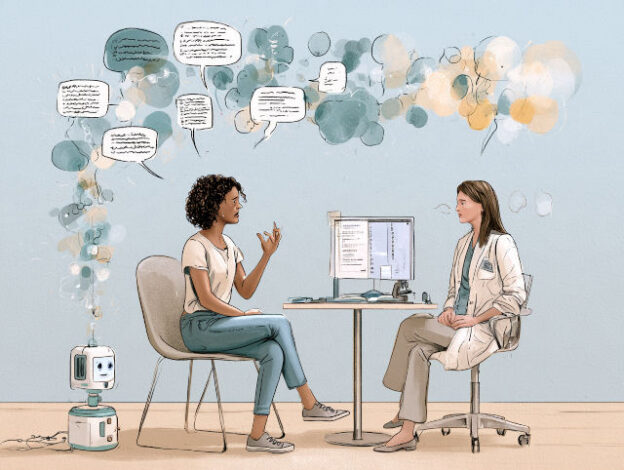
Artificial intelligence tools used to take clinical notes could change the nature of interactions between patients and healthcare professionals. They may miss important information about patients’ experiences, according to a new review.
Known as ambient AI scribes, these tools combine speech-to-text technology with AI to capture and summarise conversations during medical consultations. While they can reduce clinicians’ administrative workload, researchers warn that their growing use could have unintended consequences for patient care and clinical skills. Around 40 per cent of GPs in the UK have reported using ambient scribes.
Researchers from the University of Edinburgh reviewed 27 articles from scientific and medical literature to examine the adoption of ambient AI scribes and the implications of expanding their use. They found that although the technology can effectively capture what patients say, it may overlook other important elements of a consultation, including facial expressions, gestures and emotional states.
AI-generated summaries also tend to prioritise clinical information, potentially leaving out patients’ personal stories and experiences of illness. Researchers warn that this could result in clinical records that do not fully reflect the patient’s perspective. Patients may also be less willing to disclose sensitive information, including experiences involving substance use, domestic abuse or mental health difficulties, when they know their conversations are being recorded and processed by AI.
The review also highlights potential effects on clinicians. Manual note-taking is not simply an administrative task but can play an important role in clinical reasoning and reflection. Relying on AI scribes could encourage “cognitive offloading”, in which some of the mental effort involved in processing and recording information is transferred to technology.
Cognitive offloading can offer benefits, giving clinicians more time to engage meaningfully with patients and concentrate on complex aspects of care. However, researchers say it could also affect memory and the development of clinical skills. Some clinicians have reported not recognising AI-generated notes as their own or having difficulty remembering patients when seeing them at subsequent appointments.
The researchers say AI scribe systems should be designed to preserve patients’ voices rather than allowing automated clinical summaries to overwrite their experiences. More research is also needed into the medium- and long-term effects of these technologies in specific healthcare environments, particularly when AI systems developed in one country are introduced into healthcare systems with different practices and structures. The findings were published in BMJ Digital Health and AI.
Dr Lucas Seuren, GAIL Fellow and Research Fellow at the University of Edinburgh’s Centre for Biomedicine, Self and Society, said clinicians are understandably enthusiastic about technologies that could reduce paperwork, but patient experiences have received insufficient attention. He warned that there is a risk of patients’ stories being lost when consultations are processed by AI, potentially creating additional disadvantages for people who are already marginalised within health and social care services.
More information: Lucas Seuren et al, Beyond productivity: a NASSS-informed review of implementation risks and research priorities for ambient AI scribes in healthcare, BMJ Digital Health & AI. DOI: 10.1136/bmjdh-2026-000091
Journal information: BMJ Digital Health & AI Provided by University of Edinburgh