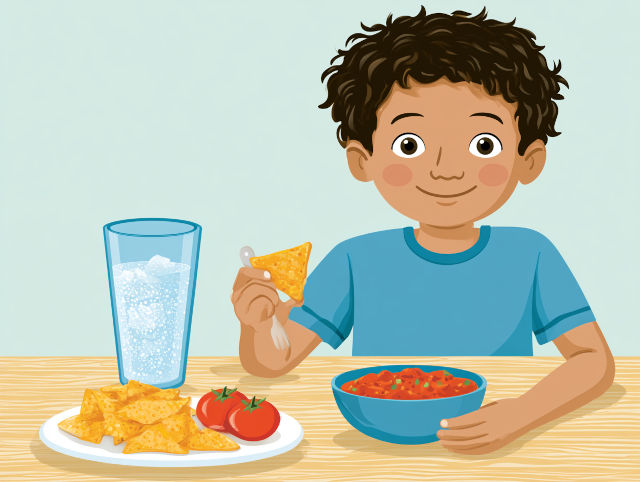
Researchers are challenging two long-standing pieces of nutrition advice: that drinking water during meals helps you eat less, and that spicy foods encourage overeating. A new study from Cornell University found little evidence that water at mealtimes promotes fullness. Instead, people who drank more water during a meal tended to eat more. At the same time, a separate experiment showed that adding extra spice to a snack slowed eating and reduced how much participants consumed overall.
The researchers found that for every additional 100 grams of water participants drank during a meal, they ate about 39 more grams of food, or roughly 49 extra calories. People who frequently alternated between bites of food and sips of water also ate more, with each additional switch linked to about 4.4 extra grams of food consumed. The team believes this may be because alternating between food and water delays sensory-specific satiety – the natural decline in a food’s appeal as you continue eating – helping meals stay enjoyable for longer.
“There’s been this widespread advice that if we drink water, it fills us up,” said Paige Cunningham, assistant professor in Cornell’s Division of Nutritional Sciences and corresponding author of the study, published in Appetite. “But water is emptied quickly from the stomach, so it likely doesn’t fill us up for long. Instead, water may increase how much we eat, providing lubrication which can speed up eating, and preventing a dry mouth which can prolong enjoyment of the food.” The analysis combined data from two previous laboratory studies involving 86 adults who ate as much beef chilli or chicken tikka masala as they wanted. At the same time, every bite and sip was recorded.
One unexpected finding was that participants who drank water more quickly during their meals actually ate less. Cunningham said the reason remains unclear and may be related to how long water stays in the mouth or reflects the overall length of a meal. “This was a secondary analysis looking at associations,” she said. “We are following up on this right now so we can make those causal inferences.”
In a separate study published in Food Quality and Preference, 49 adults ate tortilla chips with either a mild or spicy salsa, with the only difference being the amount of cayenne pepper. Participants consumed 28% less of the spicy snack and ate about 30% more slowly than when eating the mild version. Water intake remained unchanged, suggesting the reduction in food consumption was linked to the slower eating pace rather than increased thirst. “The takeaway is that adding spice to one part of the snack can significantly influence how much people eat overall,” Cunningham said.
Together, the studies suggest that common assumptions about water and spicy foods may need rethinking. Drinking more water during meals was associated with eating more, while adding spice appeared to slow eating and reduce overall food intake. However, the researchers caution that both experiments were conducted under controlled laboratory conditions using a limited range of foods, including chilli, tikka masala, tortilla chips and salsa. More research is needed to determine whether the same effects occur with different foods and in everyday eating situations.
More information: Paige Cunningham et al, Water intake, switching between bites and sips, and drinking behavior are associated with food intake across meals varying in spiciness: A secondary analysis of two randomized crossover studies, Appetite. DOI: 10.1016/j.appet.2026.108698
Journal information: Appetite Provided by Cornell University