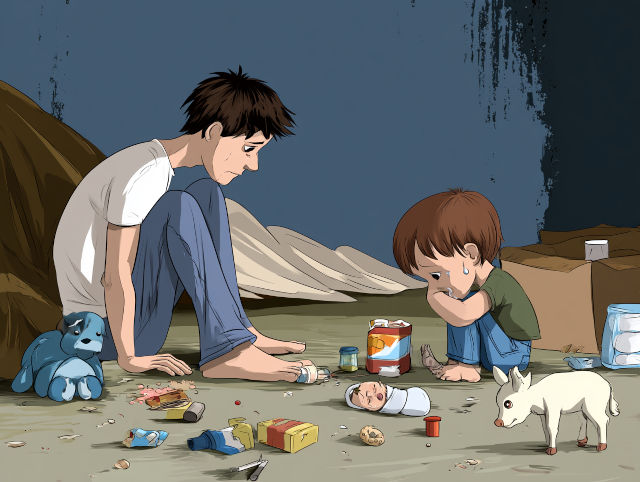
Experiencing severe stress during childhood can leave lasting effects that make people more vulnerable to anxiety, depression and other mood disorders when they face challenges later in life. Researchers from Washington University School of Medicine in St. Louis and Princeton University have uncovered a biological explanation for this long-term impact, showing that early trauma leaves a lasting imprint inside brain cells. Their findings, published Aug. 7 in Neuron, identify a molecular pathway that could eventually lead to new strategies for preventing or treating stress-related mental illness.
The team found that early-life adversity changes not only which genes are active in the brain, but also how DNA is packaged inside brain cells. These changes make genes involved in the body’s stress response easier to switch on, leaving the brain more sensitive to future stress. “We have uncovered a new biological process linking experience of early-life adversity to this long-term vulnerability to mental illness,” said Meaghan Creed, PhD, associate professor of anesthesiology at Washington University School of Medicine. She described the changes as a physical “scar” left inside brain cells that could provide a concrete target for future therapies.
More than half of children worldwide experience significant stress from abuse, violence, household dysfunction or other traumatic events, and accumulating multiple adverse experiences greatly increases the risk of mental and physical health problems in adulthood. To understand why, the researchers focused on dopamine-producing neurons in a brain region called the ventral tegmental area, which plays a key role in processing rewards, motivation and stressful experiences. Abnormal activity in these neurons has long been linked to anxiety and depression.
The scientists examined the epigenome — the collection of chemical markers that regulate whether genes are turned on or off without changing the DNA sequence itself. They discovered that early-life stress increased levels of an enzyme called SETD7 in dopamine neurons. SETD7 adds a chemical tag known as H3K4me1 to DNA-associated proteins, causing tightly packed DNA to loosen. This more open structure makes stress-related genes easier to activate, effectively leaving the brain on higher alert and more reactive to future adversity.
Experiments in mice confirmed the enzyme’s central role. Young mice engineered to produce extra SETD7, even without experiencing early-life stress, developed the same open DNA structure seen in stressed animals. As adults, they showed heightened activity in dopamine neurons, lower tolerance to stress and more anxiety-like behaviour. In contrast, blocking SETD7 after early-life stress prevented these changes. Despite experiencing stress during both childhood and adulthood, treated mice maintained normal brain activity and behaved similarly to unstressed animals.
The findings provide one of the clearest explanations yet for how childhood adversity can have lifelong effects on mental health. “There are currently no treatments for what early-life stress does to the brain, partially because we have not had a clear picture of what molecular mechanisms to target,” said Catherine Jensen Peña, PhD, assistant professor at the Princeton Neuroscience Institute. She added that the research also highlights the importance of providing children with supportive care, therapy and social resources during critical stages of development, which may help protect the brain and strengthen resilience against future stress.
More information: Hye Ji J. Kim et al, Early-life stress alters H3K4me1 in VTA to prime stress sensitivity, Neuron. DOI: 10.1016/j.neuron.2026.07.018
Journal information: Neuron Provided by WashU Medicine