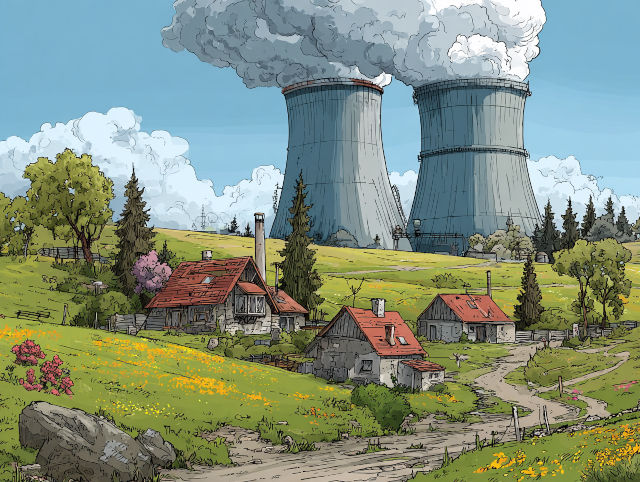
Counties in the United States located nearer to operational nuclear power plants (NPPs) experience higher cancer mortality rates than those farther away, according to a new study led by researchers at the Harvard T.H. Chan School of Public Health. While the findings identify a notable association, the researchers emphasise that they do not establish causality and instead point to the need for further investigation into the potential health impacts of nuclear energy.
This study is the first in the 21st century to examine the relationship between proximity to NPPs and cancer mortality across all U.S. counties and all operating nuclear facilities. It will be published on 23 February 2026 in Nature Communications. Previous research on this topic has produced mixed results globally, and studies within the United States have been relatively limited in scope, often focusing on a single plant and its surrounding population.
To address these gaps, the researchers conducted a nationwide analysis of cancer mortality between 2000 and 2018 using a “continuous proximity” approach. This method captures the combined influence of multiple nearby nuclear power plants rather than assessing exposure based on a single facility. Data on plant locations and operational timelines were obtained from the U.S. Energy Information Administration, including some facilities near the U.S.–Canada border. In contrast, county-level cancer mortality data were sourced from the Centers for Disease Control and Prevention.
The analysis incorporated a wide range of potential confounding factors to strengthen the validity of the findings. These included socioeconomic indicators such as educational attainment and median household income, demographic characteristics including racial composition, and environmental conditions such as average temperature and humidity. Health-related variables, including smoking prevalence, body mass index (BMI), and proximity to healthcare services, were also accounted for in the statistical models.
The results showed a consistent pattern: counties closer to nuclear power plants had higher cancer mortality rates, even after adjusting for these variables. Over the 18-year study period, the researchers estimated that approximately 115,000 cancer deaths in the United States—equivalent to around 6,400 annually—could be associated with proximity to NPPs. The observed relationship was particularly pronounced among older adults, suggesting that age may influence vulnerability to potential risks.
The findings align with earlier research conducted by the same team in Massachusetts, which reported higher cancer incidence among populations living closer to nuclear facilities. However, the researchers acknowledged several limitations, including the absence of direct radiation measurements and the assumption of equal impact across all NPPs. Overall, the study underscores the importance of continued research, particularly as nuclear power is increasingly promoted as a low-carbon energy source in efforts to address climate change.
More information: Yazan Alwadi et al, National analysis of cancer mortality and proximity to nuclear power plants in the United States, Nature Communications. DOI: 10.1038/s41467-026-69285-4
Journal information: Nature Communications Provided by Harvard T.H. Chan School of Public Health