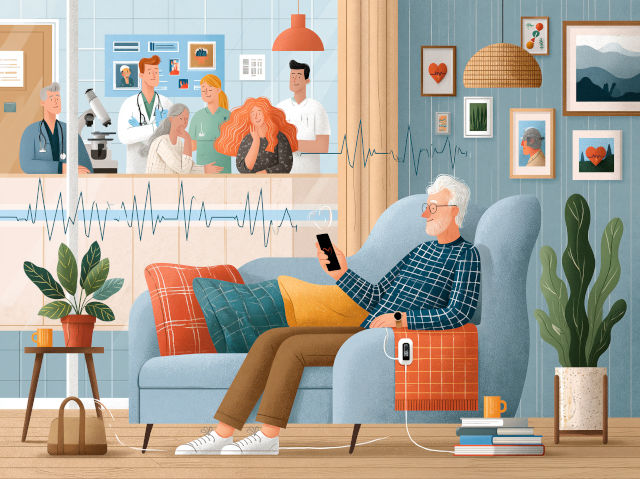
A new study published in JAMA Cardiology shows that smartphone-based heart rhythm monitoring from home can significantly reduce same-day cancellations of planned electrical cardioversion procedures in patients with atrial fibrillation. Researchers from Karolinska Institutet and Danderyd Hospital found that the approach could also help save substantial healthcare resources by identifying patients who had already returned to normal heart rhythm before arriving for treatment.
Atrial fibrillation is the most common cardiac arrhythmia in adults and causes the heart to beat irregularly, often too quickly. When medication is not sufficient to control symptoms, electrical cardioversion is commonly used to restore a normal heart rhythm. During the procedure, patients receive a controlled electrical impulse while under brief general anaesthesia. Although the treatment is well established and effective, it requires specialised staff, careful scheduling, and hospital resources. A common challenge is that some patients spontaneously return to normal heart rhythm before the procedure, often without being aware of it, resulting in last-minute cancellations and unused healthcare resources.
The randomised clinical trial was conducted at Danderyd Hospital in Stockholm between 2022 and 2025 and included patients scheduled for electrical cardioversion due to atrial fibrillation. Researchers evaluated whether daily home monitoring with a smartphone could reduce unnecessary same-day cancellations. The technology, known as CORAI, uses photoplethysmography (PPG), where the smartphone camera measures small changes in blood flow through the fingertip. By analysing pulse waves, the system can assess heart rhythm with high accuracy.
Patients assigned to the active monitoring group recorded their heart rhythm twice daily for one to two weeks before their scheduled cardioversion. If the recordings suggested that a patient had already returned to normal rhythm, the patient was contacted, and the finding was confirmed using a standard ECG. The cardioversion could then be cancelled in advance if no longer needed. Patients in the control group received standard care without smartphone monitoring.
A total of 206 patients participated in the study. Among patients using smartphone monitoring, only 4.8 percent experienced same-day cancellations, compared with 23.2 percent in the control group. When focusing specifically on cancellations caused by spontaneous return to normal heart rhythm, the difference was even more striking: 1.0 percent in the monitored group compared with 18.2 percent in the standard care group, representing a relative risk reduction of 94.7 percent. According to Jonatan Fernstad, a physician, engineer, and cardiology researcher at Karolinska Institutet who developed the technology, the findings demonstrate that patients can successfully monitor their own heart rhythm from home while helping healthcare systems avoid unnecessary visits and procedures.
The researchers also noted that 99 percent of study participants owned a smartphone, despite a median age of 70 years, suggesting strong potential for broader clinical use among older adults. In the control group, many patients appeared to have already returned to normal heart rhythm before cardioversion, yet very few contacted healthcare providers to discuss cancelling the procedure. Johan Engdahl, professor of cardiology at Karolinska Institutet and senior consultant at Danderyd Hospital, said the technology could improve access to heart rhythm assessment more broadly. He added that future studies will explore how effectively smartphone-based monitoring can detect previously undiagnosed atrial fibrillation, an important goal given that untreated atrial fibrillation increases the risk of stroke and heart failure.
More information: Jonatan Fernstad et al, Precardioversion Heart Rhythm Monitoring Using Smartphone Photoplethysmography The SMARTBEATS Randomized Clinical Trial, JAMA Cardiology. DOI: 10.1001/jamacardio.2026.1269
Journal information: JAMA Cardiology Provided by Karolinska Institutet